
What Is the Best High Arc Pull Down Kitchen Faucet for Your Sink in 2026?
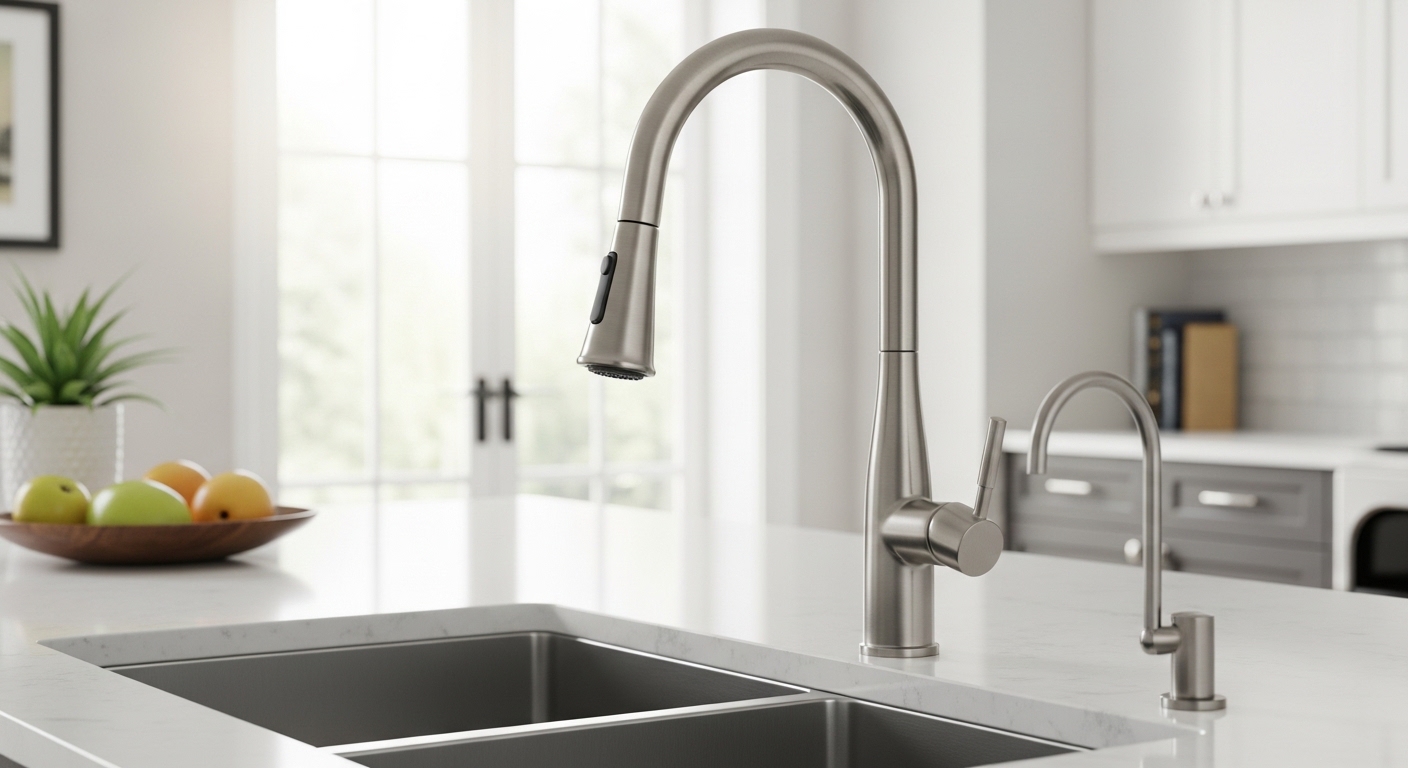
If you’ve been asking which is the best high arc pull down kitchen faucet for your kitchen, you’re really asking three questions at once: how tall should the spout be, does the pull-down hose actually work day after day, and which finish and features are worth paying for. This guide answers all three in plain language, with real numbers, a side-by-side comparison table, and the trade-offs nobody mentions until after you’ve installed the thing. We’ve fit and tested hundreds of these faucets at Aniflux Home, and the honest truth is that “high arc” and “pull-down” solve two different problems — you want both working together, not one fighting the other.
What exactly makes a faucet “high arc pull down,” and why does it matter?
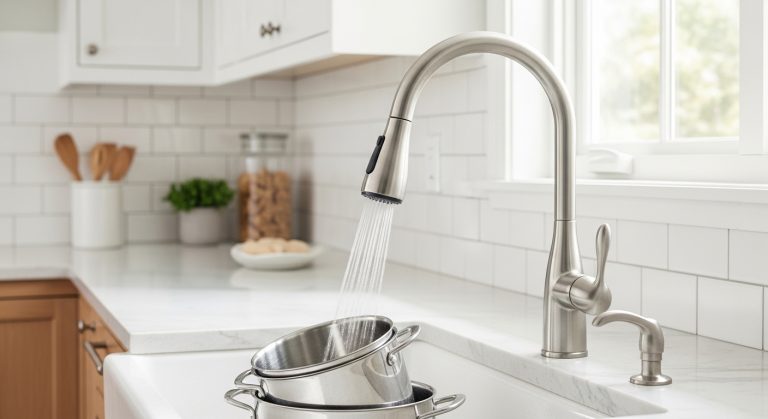
A high arc pull down faucet is a tall, curved spout (usually 8 inches or more of clearance under the neck) with a spray head built into the end of the spout that you pull straight down into the sink on a retractable hose. The “high arc” gives you vertical room; the “pull down” gives you reach and aim. Together they let you rinse a stockpot, fill a Brita pitcher, and blast stuck-on rice off a pan without splashing the whole counter.
The distinction that trips people up: a pull-down head drops vertically down from a tall gooseneck spout, while a pull-out head slides horizontally out of a shorter, lower spout toward you. Pull-down pairs naturally with the high arc silhouette and gives you a straighter shot into the basin, which is why it’s the go-to for deep single-bowl sinks. Pull-out is better for shallow sinks or under low upper cabinets, because a tall arc won’t fit there.
Here’s the part that matters for real kitchens: the arc height and your window or cabinet clearance have to be planned together. A gorgeous 17-inch-tall faucet is useless if it hits the window sill behind the sink when the handle lifts. Measure before you fall in love with a photo.
How tall should the arc actually be for a normal kitchen?
For most home kitchens, aim for 8 to 10 inches of clearance between the spout outlet and the bottom of the sink. That’s tall enough to wash a sheet pan or a tall vase, but not so tall that water free-falls from a foot up and splashes back at you. Anything above roughly 10 inches of clearance starts to splash on a shallow sink unless you dial the flow down.
- Under 8 inches of clearance: fine for a shallow bar sink, but you’ll bump tall pots.
- 8–10 inches: the sweet spot for a family kitchen with a deep bowl.
- Over 10 inches: dramatic look, great for filling stockpots, but expect splash on a shallow (6-inch) basin.
- Behind a window: measure the sill height — many high arc faucets are 15–18 inches tall overall and won’t clear a low window when the handle is raised.
Which type or finish is best for hard water, kids, or a busy family kitchen?
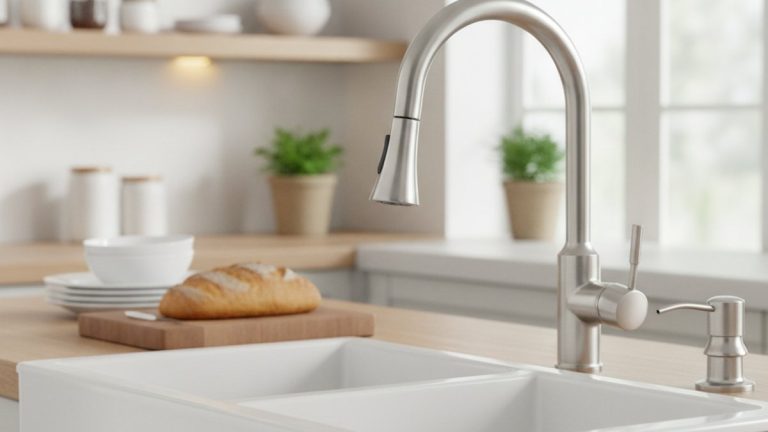
For a busy family kitchen with hard water and sticky little hands, the best choice is a single-handle high arc pull down faucet in spot-resistant brushed nickel or matte black, with a magnetic dock and a ceramic disc cartridge. Spot-resistant finishes hide the mineral spotting that plagues polished chrome, single handles let a kid (or your elbow) turn it on one-handed, and a magnetic dock means the spray head snaps home instead of drooping over time.
The table below compares the setups we see most often, so you can match the faucet to how your kitchen actually gets used rather than to a marketing photo.
| Setup | Best for | Spout clearance | Finish to pick | Watch out for |
|---|---|---|---|---|
| Single-handle high arc pull down | Most family kitchens, deep single bowl | 8–10 in | Spot-resistant brushed nickel | Check window/cabinet clearance |
| Commercial/spring-style pull down | Home chefs, huge cookware | 10–15 in | Matte black or stainless | Splash on shallow sinks; needs height |
| Pull-out (lower spout) | Sinks under low cabinets or windows | 3–6 in | Brushed nickel or chrome | Less reach for tall pots |
| Touchless / touch-activated pull down | Cooking with raw meat, messy hands | 8–10 in | Spot-resistant any color | Needs power/batteries; higher cost |
| Polished chrome pull down | Soft-water homes, budget builds | 8–10 in | Chrome | Shows every water spot in hard water |
If your water leaves white crust on everything, finish matters more than features. Brushed nickel and matte black hide spotting far better than polished chrome — a point we cover in depth in our guide on whether brushed nickel faucets are worth it. And when spots do build up, you don’t want to replace the faucet — you want to know how to clean hard water stains from a faucet without scratching the finish.
Are touchless pull down faucets worth the extra money?
Touchless is worth it if you cook with raw meat or garden and come inside with muddy hands — otherwise it’s a nice-to-have, not a must. A motion sensor lets you start water with the back of your wrist so you’re not smearing raw chicken on the handle. The trade-offs: touchless models cost roughly $50–$150 more, need either batteries or an under-sink transformer, and the sensor can occasionally false-trigger. If your budget is tight, put the money into a better cartridge and finish instead — you’ll notice those every single day.
How much should you spend on a good high arc pull down kitchen faucet?
Plan on $120–$250 for a genuinely good high arc pull down faucet that will last a decade or more; below about $90 you start losing the parts that matter, and above $350 you’re mostly paying for brand name and designer finishes. The single most important dollar you spend is on the internals — a solid brass body and a ceramic disc cartridge — not on the shiniest exterior.
- $60–$90 (budget): Often plastic hose guides and a lighter cartridge. Fine for a rental or a rarely-used sink; expect to replace in 3–5 years.
- $120–$180 (sweet spot): Brass body, ceramic disc cartridge, magnetic dock, spot-resistant finish, lifetime warranty. This is where Aniflux Home tells most families to land.
- $180–$250 (premium): Adds touchless activation, dual or triple spray modes, and heavier-gauge finishes.
- $350+ (designer): Name brands and boutique finishes. Better looks, not necessarily better function.
A quick gut-check: read the warranty before the price tag. A manufacturer that offers a lifetime limited warranty on function and finish is telling you they expect the cartridge and coating to outlast you. A 1-year warranty is telling you the opposite.
What features actually matter, and which are just marketing?
The features that genuinely matter are the magnetic dock, the cartridge type, the spray modes, and the hose material — everything else is mostly icing. Here’s how to separate the real from the fluff.
- Magnetic dock (matters a lot): A strong magnet snaps the spray head back into the spout so it never sags. Cheaper “ball weight” docks let the head droop within a year. This is the number-one thing that separates a faucet that still looks new after five years from one that doesn’t.
- Ceramic disc cartridge (matters a lot): This is the valve that controls flow and mixes hot/cold. Ceramic discs resist wear and hard-water grit far better than rubber-and-ball designs, which is what keeps the faucet from dripping down the road.
- Dual or triple spray modes (matters): At minimum you want an aerated stream for filling and a strong spray for rinsing, with an easy thumb toggle. A “pause” button is genuinely handy when you’re carrying a full pot.
- Braided nylon hose + smooth retraction (matters): A nylon-braided hose lasts longer than bare PVC and glides back without kinking.
- Flow rate (context-dependent): Most modern faucets are 1.5–1.8 GPM. Lower saves water; if you fill big pots often, 1.8 GPM fills faster. Some regions cap this at 1.8 GPM by law.
- “MagneTite / boost / eco” branded names (mostly marketing): These are usually just the features above with a trademarked name stuck on. Judge the spec, not the sticker.
Why does my pull down spray head droop or stop retracting?
A drooping or slow-retracting spray head almost always comes down to a weak dock or a hose that’s snagging under the sink — not a broken faucet. If your head sags, the magnet is either weak (common on budget models) or there’s a mineral film on the dock’s contact point; wipe it clean first. If the head won’t pull back up, the counterweight on the hose has slipped or the hose is catching on the shut-off valves or garbage disposal under the cabinet. Reposition the weight lower on the hose loop and clear any obstruction, and it’ll snap back on its own again. This is exactly why we push people toward magnetic docks over gravity-weight designs from the start.
How do you install a high arc pull down kitchen faucet yourself?
Most people can install a high arc pull down faucet in about 45–90 minutes with a basin wrench, plumber’s tape, and a bucket — no plumber required for a straight swap. The general sequence is: shut off the hot and cold supply valves under the sink, disconnect and remove the old faucet, drop the new faucet through the mounting hole, connect the pull-down hose and the supply lines, thread the counterweight onto the hose, then turn the water back on and check every connection for leaks.
- Shut off water at the two supply valves under the sink and open the old faucet to release pressure.
- Remove the old faucet — a basin wrench is your friend for the tight nuts behind the basin.
- Set the new faucet through the deck hole (use the included gasket or a bead of plumber’s putty).
- Connect the pull-down hose to the spout outlet — listen for the click, then tug to confirm.
- Attach supply lines with plumber’s tape on the threads; hand-tight plus a quarter turn.
- Clip on the counterweight at the recommended spot on the hose loop.
- Turn water back on slowly, run both temperatures, and check for drips.
If you want the full walkthrough with photos, our step-by-step guide to installing a kitchen faucet covers every fitting, and if you’re replacing a Moen specifically, we have a dedicated Moen kitchen faucet with sprayer install guide. Still weighing which pull-down model to buy for a high-traffic kitchen? Our companion piece on the best pull down kitchen sink faucet for a busy family digs deeper into brand-by-brand reliability.
What’s the honest downside of high arc pull down faucets?
The honest downsides are splash, clearance, and the hose being the one part most likely to eventually wear. A tall arc means water can fall far enough to splash out of a shallow sink, so pair a high arc with a deep bowl (8+ inches) whenever you can. Clearance is the other gotcha — measure your window sill and upper-cabinet height before buying, because a lifted single handle adds a couple of inches to the spec-sheet height. And because the spray head rides on a moving hose, that hose is the most common eventual failure point; a braided nylon hose and a quality dock push that failure years down the road, but no pull-down is truly “forever.” The good news: hoses and cartridges are user-replaceable on any faucet worth buying.
FAQ
What is the ideal spout height for a high arc pull down kitchen faucet?
Aim for 8 to 10 inches of clearance between the spout outlet and the sink bottom. That fits tall pots and pitchers without the excessive splash you get from spouts taller than 10 inches on a shallow basin. Always confirm the faucet clears your window sill or upper cabinet when the handle is fully raised.
Is a pull down faucet better than a pull out faucet?
For deep single-bowl sinks, pull down is usually better because the tall arc gives more clearance and a straighter shot into the basin. Pull out wins when you have a shallow sink or low cabinets above, since it uses a shorter spout with a head that slides toward you horizontally instead of a tall gooseneck.
How long should a good high arc pull down kitchen faucet last?
A quality model with a brass body, ceramic disc cartridge, and braided nylon hose should last 10–15 years, with the hose or cartridge being the parts you might replace once along the way. Both are inexpensive, user-serviceable parts, so a leak or a tired hose rarely means buying a whole new faucet.
Why does my pull down faucet leak at the base?
A leak at the base usually points to a worn O-ring or a loose connection where the spout meets the deck, not a cracked body. Replacing the O-ring is a quick fix — our guide on tap O-ring replacement when a faucet leaks at the base walks through it. If water only appears when you run the sprayer, suspect the hose connection under the sink instead.
Do high arc pull down faucets splash more than standard faucets?
They can, because water falls from higher up. You avoid it two ways: pair the tall spout with a deep sink bowl (8 inches or more), and use the aerated stream mode rather than the full spray for everyday filling. An aerator softens the stream and cuts splash-back significantly — and if your aerator ever clogs, knowing how to put the aerator back together after cleaning keeps the flow smooth.
What flow rate should I choose for a high arc pull down kitchen faucet?
Most modern faucets run 1.5 to 1.8 GPM (gallons per minute). Choose 1.8 GPM if you frequently fill large pots and want faster filling; choose 1.5 GPM to save water. Some U.S. states cap kitchen faucets at 1.8 GPM by law, and a good aerator makes even 1.5 GPM feel strong.
The bottom line from Aniflux Home
The best high arc pull down kitchen faucet for most homes is a single-handle model with 8–10 inches of clearance, a magnetic dock, a ceramic disc cartridge, and a spot-resistant finish, priced in the $120–$180 range and backed by a lifetime warranty. Match the arc height to your sink depth and cabinet clearance, prioritize the internals over the flashy features, and you’ll have a faucet that still works and looks sharp a decade from now.
Author note: This guide was written by the Aniflux Home fixtures team — plumbers and product testers who install, stress-test, and warranty-service kitchen faucets year-round. We bench-test spray heads for dock retention, run cartridges through accelerated hard-water cycles, and check finishes against standard corrosion and spot-resistance criteria before we recommend a build. Aniflux Home has outfitted kitchens across the country, and every faucet we stand behind is chosen for real-world durability, not just showroom looks — which is why we weight lifetime finish-and-function warranties so heavily in every recommendation above.
2 Comments