
What Is the Right Widespread Faucet Spacing for Your Bathroom Sink?
If you’re staring at three holes in your sink and wondering whether a new faucet will actually fit, the number you need is your widespread faucet spacing — the center-to-center distance between the two outer holes where the hot and cold handles mount. On a true widespread setup, that measurement is almost always 8 inches, which is why the industry shorthand for a widespread faucet is simply “8-inch.” But the real answer is a little more forgiving than that single number suggests, and getting it right is the difference between a clean, leak-free install and a Saturday-afternoon return trip to the store.
At Aniflux Home we sell and support widespread faucets every day, and the number-one pre-purchase question we get isn’t about finish or flow rate — it’s “will it fit my holes?” This guide answers that concretely: how to measure, what the standard spacing really is, how much adjustment you get, and what to do when your sink doesn’t cooperate.
What Is Widespread Faucet Spacing, Exactly?
Widespread faucet spacing is the center-to-center distance between the two outer mounting holes — the ones your handles drop into. It is not the width of the faucet, not the length of the spout, and not the distance edge-to-edge. Measure from the dead center of the left hole to the dead center of the right hole. That single number is what determines whether a widespread faucet fits.
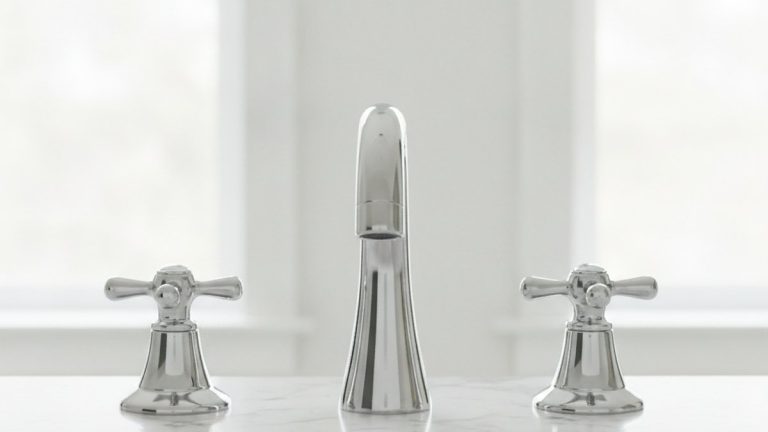
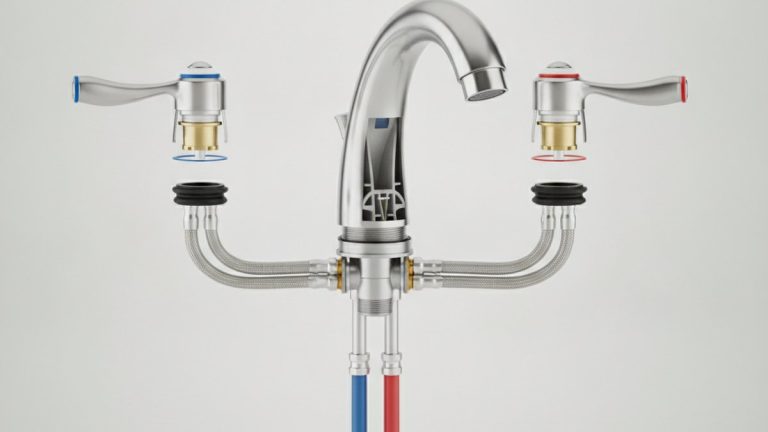
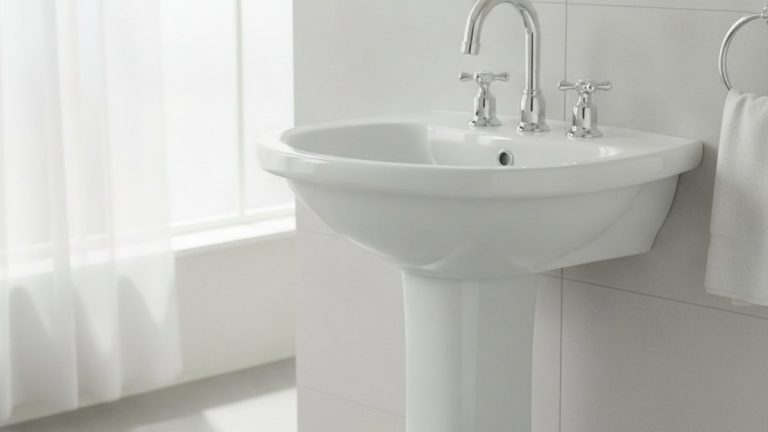
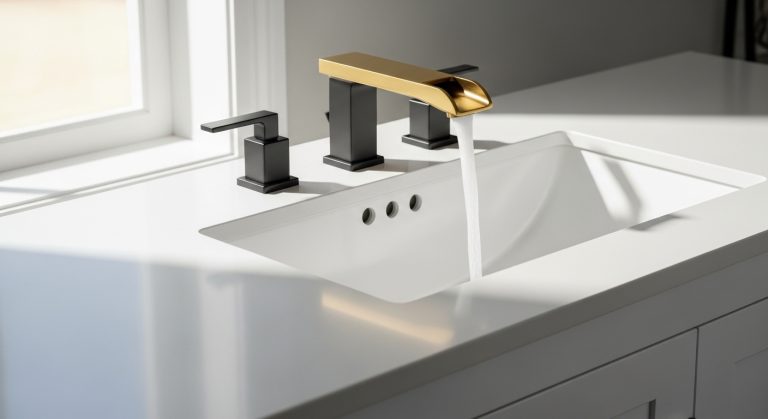
A widespread faucet is a three-piece design: a separate spout in the middle and two independent handles, each connected to the spout underneath the sink by flexible supply lines. Because the three pieces aren’t joined by a solid baseplate, they can slide apart or together, which is exactly why widespread faucets accommodate a range of spacing rather than one rigid dimension. The trade-off is that “widespread” describes a category, and within it the standard on-center measurement is what you’re matching to your sink.
People mix this up constantly with centerset and single-hole faucets, so here’s the quick distinction: a centerset faucet mounts to holes spaced 4 inches apart and typically rides on a single baseplate. A widespread faucet mounts to holes 8 inches apart (nominally) with three fully separate pieces. If you want the deeper breakdown of the two styles, we cover it in detail in our guide on centerset vs. widespread faucets and what the difference actually means.
What Is the Standard Widespread Faucet Spacing — Is It Always 8 Inches?
The standard is 8 inches on center, and that’s the number you’ll see on the vast majority of product pages. But “8 inches” is the nominal spec, not a hard requirement — most widespread faucets are engineered to install cleanly anywhere from about 6 to 16 inches on center. The 8-inch figure exists because it’s the most common pre-drilled spacing on U.S. bathroom sinks and vanity tops.
Here’s the nuance that saves people headaches: because the handles connect to the spout with flexible hoses under the counter, you’re not locked to a precise 8.000 inches. If your holes measure 8 1/4 inches or 7 3/4 inches, a standard widespread faucet will still install and look correct. The visible parts sit over each hole independently, and the flexible lines absorb the difference below.
What you can’t do is drop a widespread faucet onto a 4-inch centerset hole pattern — the handles physically won’t reach that close together on most models, and the spout base won’t cover the gaps. That’s the boundary to respect.
| Faucet Type | Hole Spacing (center-to-center) | Number of Holes | Best For |
|---|---|---|---|
| Single-hole | 1 hole only | 1 | Small or modern vanities, minimalist look |
| Centerset | 4 inches | 3 (on one baseplate) | Compact bathrooms, budget builds |
| Widespread (standard) | 8 inches (adjustable ~6–16 in) | 3 (separate pieces) | Standard and large vanities, upscale look |
| Mini-widespread | 4 inches | 3 (separate pieces) | Widespread style on a centerset hole pattern |
| Wall-mount | Varies (often 8 in) | Wall-drilled | Vessel sinks, custom vanities |
How Do You Measure Widespread Faucet Spacing Before You Buy?
Measure center-to-center between the two outer holes: put a tape measure across the sink, line up the start on the middle of the left hole, and read the number at the middle of the right hole. If your holes are pre-drilled 8 inches apart, buy a standard widespread faucet. It takes 30 seconds and it’s the only measurement that truly matters for fit.
Do this before you fall in love with any specific model. A few practical tips to get an accurate reading:
- Measure from center to center, never edge to edge. Edge-to-edge readings run about a half-inch short because hole diameters (usually 1 1/4 to 1 3/8 inches) throw off the math.
- Ignore the middle hole for spacing. The center spout hole doesn’t factor into the on-center number — it should sit roughly halfway between the outer two.
- Check the hole diameter too. Standard faucet holes are 1 3/8 inch. If yours are smaller, some widespread valve bodies won’t pass through.
- Confirm the deck depth behind the sink. You need room between the back holes and the wall/backsplash so the handles clear and you can turn a wrench underneath.
- If the sink isn’t installed yet, the spec sheet for your sink or vanity top will list the drilling as “8 in. widespread” or “4 in. centerset.”
Will a Widespread Faucet Fit My Existing Holes — What If They’re Not 8 Inches?
If your outer holes measure anywhere from about 6 to 16 inches apart, a standard adjustable widespread faucet will fit — that’s the whole point of the flexible under-counter connections. If your holes are 4 inches apart, you need a mini-widespread (also sold as “4-inch widespread”) instead, which gives you the three-piece look on a centerset drilling.
Let’s walk the common real-world scenarios:
- Holes at 8 inches: Textbook fit. Any standard widespread works.
- Holes at 6, 10, or 12 inches: Still fine for most widespread models — check the product’s stated adjustable range, which reputable brands list on the spec sheet.
- Holes at 4 inches: Go with a mini-widespread, or switch to a centerset faucet. A full-size widespread won’t close that gap.
- Single hole in the sink: You can’t install a widespread without drilling two more holes, which is only possible on some materials. A single-hole faucet is the practical fix.
- Holes wider than 16 inches: Rare on a bathroom sink, but you’d need a faucet with an extra-long adjustable range or extended supply lines.
One thing worth flagging: the spout and handle bases on a widespread cover a fixed footprint. If your holes are on the very wide end of the range, double-check the supply hoses that come in the box are long enough to reach from each handle back to the center spout tee. Most quality faucets ship with generous hoses, but budget models occasionally run short. If you’re shopping the value end of the market, our roundup of the best widespread bathroom faucets under $100 notes which ones give you enough hose length to work with.
Why Choose Widespread Spacing Over Centerset — Is It Worth the Extra Cost?
Widespread spacing is worth it when you have the counter space and want a more premium, customizable look — the separated handles read as higher-end and let you position hot and cold ergonomically. Centerset is the better call for tight vanities and tighter budgets. It’s a design-and-fit decision more than a performance one; both deliver the same water.
The practical advantages of an 8-inch widespread layout:
- Cleaner sightlines. The gap between the spout and handles shows off the countertop and looks intentional on a wide vanity.
- Ergonomics. Handles sit where your hands naturally land, and there’s more elbow room around the spout.
- Easier cleaning. No single baseplate means fewer crevices where grime and hard-water crust collect. (And if you’re already fighting mineral buildup, here’s how to clean hard water stains from a faucet the right way.)
- Repairability. Because the pieces are independent, you can service one handle valve without disturbing the rest.
The downsides are honest ones: widespread faucets cost more, take a bit longer to install because you’re connecting three separate pieces, and demand more deck space. On a powder-room vanity that’s only 18 inches wide, an 8-inch widespread can look cramped and a centerset or single-hole is the smarter pick. If you’re weighing the whole decision — style, holes, finish, budget — our overall guide to choosing the right bathroom faucet walks through it step by step.
How Do You Install a Widespread Faucet Once the Spacing Matches?
Once your holes match the faucet’s spacing range, installation is straightforward: mount the spout in the center hole, drop a handle valve into each outer hole, connect the handles to the spout with the included hoses under the counter, then hook up your water supply lines. Budget 45 to 90 minutes for a first-timer.
The basic sequence:
- Shut off the water at the valves under the sink and open the old faucet to drain the lines.
- Remove the old faucet and clean the deck around all three holes.
- Set the spout in the center hole with its gasket or a bead of plumber’s putty, and hand-tighten the mounting nut from below.
- Install each handle valve in the outer holes, checking that hot goes left and cold goes right.
- Connect the handles to the spout using the flexible tee hoses — this is the step the widespread design makes flexible, so the exact hole spacing doesn’t have to be perfect.
- Attach the supply lines from the shutoff valves to each handle inlet.
- Turn the water back on slowly and check every connection for drips before you call it done.
Snug is the goal on every threaded connection — hand-tight plus a gentle quarter-turn with a wrench. Overtightening cracks plastic nuts and crushes gaskets, which is a leading cause of a brand-new faucet that weeps at the base. If yours does start dripping down the road, the culprit is usually a worn O-ring, and you can handle that yourself using our walkthrough on replacing a bathroom faucet O-ring.
What About Commercial or High-Traffic Restrooms?
For commercial restrooms, widespread spacing is still typically 8 inches on center, but you’ll often want a metering (self-closing) valve body instead of standard handles to save water and prevent taps being left running. The hole pattern is the same; the internal valve is what changes.
If you’re specifying faucets for an office, restaurant, or public restroom, the 8-inch widespread drilling remains the norm, which keeps replacement parts easy to source. The main upgrade is a push-and-release metering cartridge that shuts the water off automatically after a set number of seconds. We break down whether that’s the right move — and how the spacing plays in — in our guide to the widespread metering faucet for commercial restrooms. For high-end residential builds where you want something that stands out visually while still hitting standard spacing, our piece on picking a unique widespread faucet that actually fits your sink is a good companion read.
How We Test and Why You Can Trust This Guidance
Every widespread faucet Aniflux Home carries is bench-checked against its stated adjustable spacing range and cycle-tested for handle and cartridge durability before it earns a spot in our catalog. We build to widely recognized North American plumbing standards for faucet fit and lead-free wetted surfaces, and our widespread bathroom faucets ship with a limited lifetime warranty on finish and function, backed by U.S.-based support that can help you confirm fit before you order.
Author note: This guide was written by the Aniflux Home fixtures team — the same people who answer “will it fit my holes?” tickets, process fit-related returns, and spec faucets for both homeowners and contractors. The measurements and ranges here reflect what we actually see across hundreds of installs, not just a manufacturer’s ideal-case spec sheet.
FAQ
Is widespread faucet spacing always 8 inches?
Eight inches on center is the standard and the most common pre-drilled spacing, but most widespread faucets adjust to fit roughly 6 to 16 inches thanks to their flexible under-counter connections. Always measure your outer holes center-to-center and check the faucet’s stated range before buying.
How do I measure the spacing for a widespread faucet?
Measure from the exact center of the left outer hole to the exact center of the right outer hole. Don’t measure edge-to-edge, and ignore the middle spout hole for this number. That center-to-center figure is what you match to the faucet’s spec.
Can I put a widespread faucet on a sink with 4-inch spacing?
Not a standard widespread — the handles won’t reach that close together and the gaps won’t be covered. Instead, choose a mini-widespread (also called a 4-inch widespread), which gives you the three-piece look designed specifically for a 4-inch centerset hole pattern.
What’s the difference between widespread and centerset spacing?
Centerset spacing is 4 inches on center, usually on a single baseplate. Widespread spacing is 8 inches (adjustable) with three fully separate pieces. Widespread suits larger vanities and a more upscale look; centerset suits compact bathrooms and tighter budgets.
Will a widespread faucet fit if my holes are slightly off from 8 inches?
Yes. Because the handles connect to the spout with flexible hoses under the counter, small variances like 7 3/4 or 8 1/4 inches install cleanly and look correct. Only a big mismatch — such as trying to use a full-size widespread on 4-inch holes — is a genuine problem.
Do widespread faucets need three holes?
Yes — one center hole for the spout and one outer hole for each handle, three total. If your sink has only one hole, you’d have to drill two more (not possible in every material), so a single-hole faucet is usually the more practical choice.
4 Comments