What Is a Widespread Metering Faucet, and Is It the Right Choice for Your Commercial Restroom?
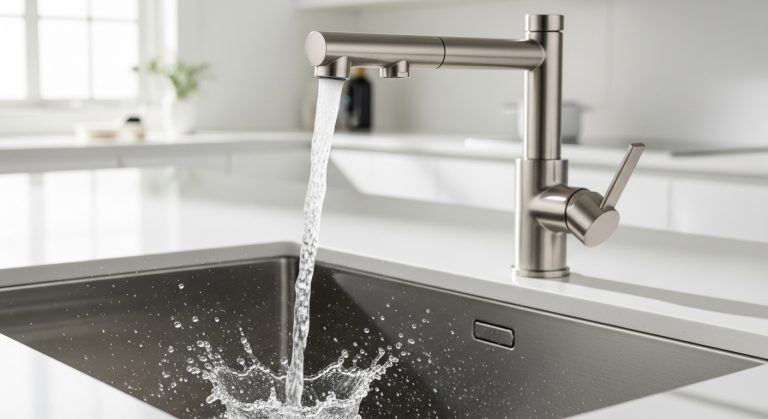
If you manage an office, restaurant, school, or gym restroom, a widespread metering faucet is one of the few upgrades that pays for itself. It combines two ideas that used to live in separate products: the classic widespread layout (a spout with two independent handles set 8 inches apart on center) and a metering valve (a self-closing cartridge that dispenses a measured amount of water, then stops on its own). The result is a fixture that looks presentable in a nicer commercial space but behaves like a workhorse — no drips left running overnight, no vandalized handles stuck open, and predictable water bills.
Below, I’ll walk through exactly how these faucets work, where they make sense (and where they don’t), how they compare to sensor and push-button alternatives, what specs actually matter when you buy, and how to size and install one correctly. This is the guide I wish facility managers had before they over-ordered the wrong valve type.
What exactly makes a faucet “widespread” AND “metering”?
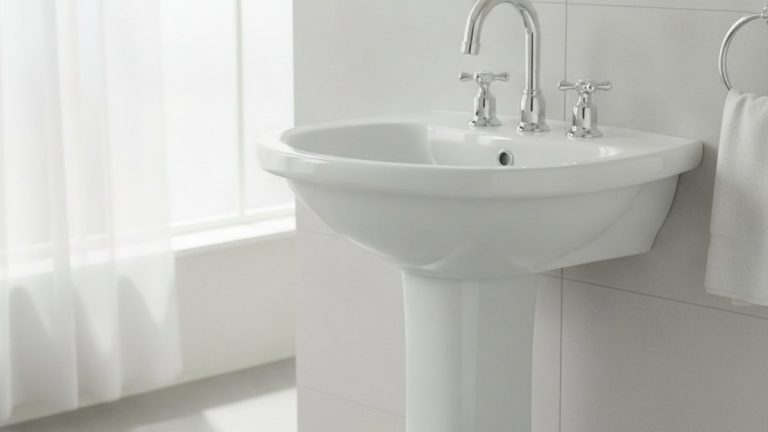
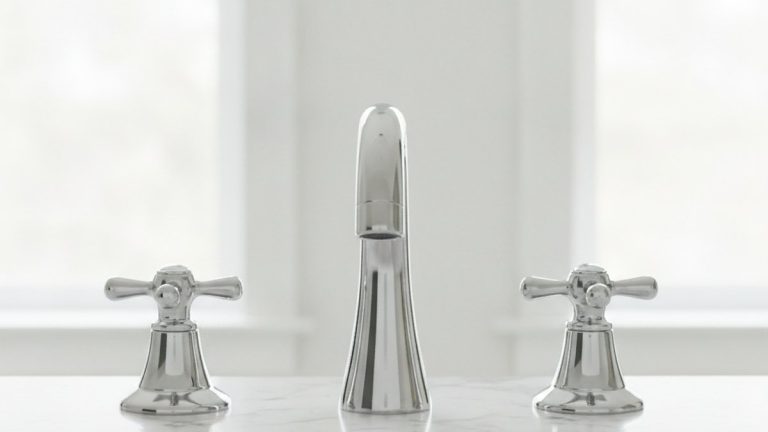
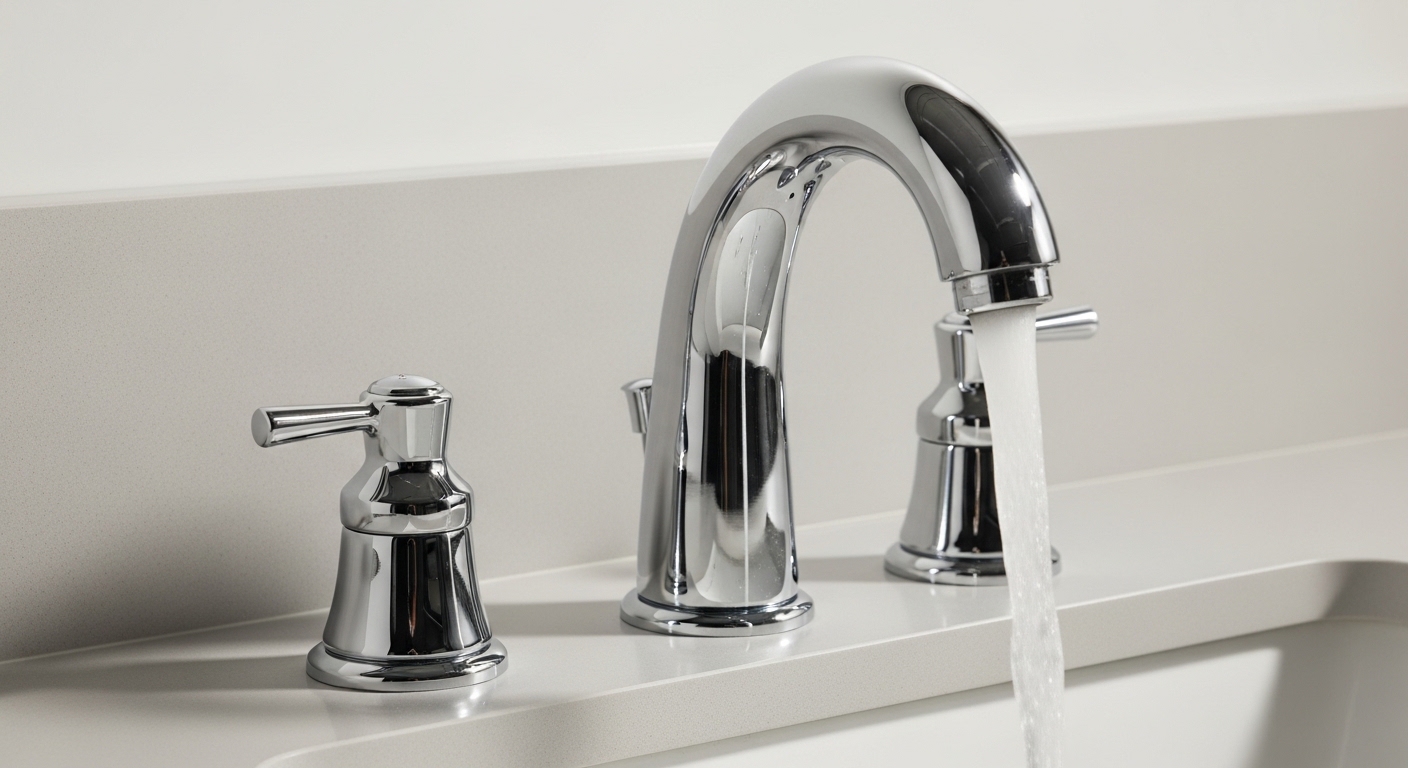
Two separate specs are stacked in that name. Widespread describes the mounting layout: three separate holes in the deck — a spout in the middle and a handle on each side — with the outer holes drilled 8 inches apart on center (the industry standard, though widespread can range from about 6 to 16 inches). Metering describes the valve behavior: press or turn the handle, and the faucet runs for a fixed, factory-set interval — typically 10 to 15 seconds — then closes itself automatically.
So a widespread metering faucet is the intersection of the two: an 8-inch-spread, three-hole faucet whose handles are self-closing metering valves instead of standard compression or ceramic-disc valves that stay open until a person turns them off.
- Widespread (layout): spout and handles are independent pieces connected under the deck by flexible supply lines, giving you flexible spacing and an upscale look.
- Metering (function): a spring-loaded, time-limited cartridge that guarantees the water turns off — the single biggest cause of wasted water in public restrooms is a faucet left running.
- The combo: commercial-grade water control in a fixture that still coordinates with nicer counters, unlike a bare deck-mounted push valve.
If you’re still deciding between the widespread layout and a tighter one, our explainer on centerset vs. widespread faucets and what the difference actually is breaks down the hole spacing and why it matters before you drill anything.
How long does a metering faucet run before it shuts off?
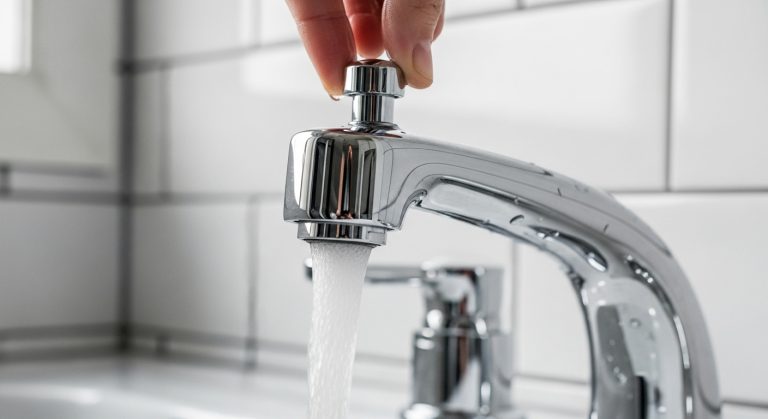
Most widespread metering faucets run for 10 to 15 seconds per activation, and better models let you adjust that cycle time — often anywhere from about 4 to 30 seconds — by turning a screw or shim inside the cartridge. That single spec drives both your water savings and how annoyed your users get, so it’s worth setting deliberately.
Here’s the trade-off in plain terms. A shorter cycle (7–10 seconds) saves the most water and is ideal for hand-rinsing in a fast-food restroom or a stadium. A longer cycle (15–20 seconds) feels more natural for offices, medical facilities, or anywhere people actually wash for the CDC-recommended 20 seconds and don’t want to slap the handle three times. The right answer depends on your traffic and your tolerance for repeat presses.
Water use per cycle is a function of two numbers: the run time and the flow rate. A metering faucet flowing at 0.5 gallons per minute (gpm) for a 10-second cycle uses roughly 0.083 gallons per hand-wash. Compare that to a standard faucet left running at 1.2 gpm for 45 careless seconds — about 0.9 gallons — and you can see how a busy restroom saves thousands of gallons a year just by removing the “left on” failure mode.
Widespread metering vs. sensor vs. push-button: which should a commercial restroom buy?
Choose a widespread metering faucet when you want mechanical reliability, no batteries or power, and a more finished look than an industrial push valve — but you don’t need fully touch-free operation. Sensor (touchless) faucets win on hygiene and ADA-effortless activation; push-button metering deck valves win on lowest cost and vandal resistance. Here’s the honest side-by-side.
| Feature | Widespread Metering | Sensor / Touchless | Push-Button Metering |
|---|---|---|---|
| Water shut-off | Automatic (timed) | Automatic (motion) | Automatic (timed) |
| Power needed | None | Battery or hardwired | None |
| Touch-free | No (press handle) | Yes | No (press top) |
| Look / finish appeal | Upscale, traditional | Modern | Utilitarian |
| Typical cycle | 10–15 sec, adjustable | Runs while hands present | 10–15 sec, adjustable |
| Vandal resistance | High | Medium (sensor exposed) | Very high |
| Maintenance cost | Low (no electronics) | Higher (batteries, solenoid) | Lowest |
| Best for | Offices, restaurants, mid-tier public restrooms | Hospitals, airports, high-hygiene sites | Parks, stadiums, budget builds |
The pattern most facility managers land on: sensor faucets for the highest-hygiene, highest-budget spaces; push-button metering for the roughest, cheapest, most abused restrooms; and widespread metering faucets for the broad middle — places that want water control and a presentable appearance without maintaining electronics or replacing batteries every year or two.
Are widespread metering faucets ADA compliant?
Yes — a properly specified widespread metering faucet can be fully ADA compliant, but two details decide it: the handle type and the run time. Under the ADA Standards, the faucet must be operable with one hand, without tight grasping, pinching, or twisting of the wrist, and with no more than 5 pounds of force. Metering faucets must also stay on for at least 10 seconds so a person doesn’t have to keep re-triggering them.
That’s why the best commercial metering faucets use wide, push-down or lever “wing” handles rather than small knobs you have to grip and twist. When you’re specifying, confirm three things:
- Handle actuation: push-down or lever type, operable with a closed fist or forearm.
- Run time ≥ 10 seconds: set the cartridge cycle to meet the minimum; many arrive pre-set at 10–15 seconds.
- Reach and mounting height: installed within ADA reach ranges over an accessible lavatory with proper knee/toe clearance.
Standard-compliant products are typically listed to ASME A112.18.1 / CSA B125.1 (the plumbing fixtures standard) and meet the flow limits of the EPA’s WaterSense program and California’s CALGreen requirements. Always check the spec sheet for those listings before you buy in quantity.
How much water (and money) does a metering faucet actually save?
A metering faucet typically cuts restroom sink water use by 30% to 70% versus a manual faucet, and the savings come almost entirely from eliminating water left running — not from the flow rate itself. In a busy public restroom, that’s the difference between a faucet that runs for a controlled 10 seconds and one that a distracted user, a running child, or a broken handle leaves streaming for minutes.
Run the math for a modest site: 200 hand-washes a day, 6 days a week. At 0.083 gallons per metered wash (0.5 gpm × 10 sec), that’s about 5,180 gallons a year at the sinks. A manual setup averaging even 0.4 gallons per wash — thanks to overshoot and the occasional left-on faucet — burns closer to 25,000 gallons for the same traffic. The gap widens fast in stadiums, schools, and highway rest stops where nobody is watching individual faucets.
Metering valves also protect against the silent budget-killer: the slow drip. A worn manual cartridge that drips one drop per second wastes roughly 3,000 gallons a year per faucet. A self-closing metering valve simply doesn’t stay in a partly-open, dripping state. If you’re already fighting drips on existing manual faucets, our guide on how to fix a dripping faucet at home will help you triage them before you decide what to replace.
What finish holds up best in a high-traffic commercial restroom?
For heavy commercial use, polished chrome is the most durable and easiest to maintain, which is why you see it in nearly every public restroom. It resists corrosion, hides nothing but wipes clean in seconds, and matches virtually any partition and fixture. Brushed nickel and stainless are close seconds and look more premium, but they show water spots and require slightly more attention in hard-water areas.
| Finish | Durability | Shows water spots? | Best commercial use |
|---|---|---|---|
| Polished Chrome | Excellent | Minimal | High-traffic public restrooms |
| Brushed Nickel | Very good | Hides them well | Offices, hotels, upscale spaces |
| Brushed / Satin Stainless | Excellent | Some | Restaurants, healthcare |
| Matte Black | Good (needs care) | Very visible in hard water | Boutique, low-to-mid traffic |
In hard-water regions, finish choice matters even more because mineral scale builds on the aerator and around the handles. If your building has hard water, plan a regular wipe-down routine — our walkthrough on how to clean hard water stains from a faucet applies directly to metering aerators, which can clog and reduce flow if scale is ignored. And if you want the full reasoning behind the most popular non-chrome option, this piece on whether brushed nickel faucets are worth it covers the trade-offs for a lighter-traffic space.
Can you install a widespread metering faucet yourself?
Yes, a widespread metering faucet installs much like any three-hole widespread faucet — if your sink or countertop already has three holes drilled on 8-inch centers, it’s a straightforward swap that a handy facilities person can do in about 30–45 minutes. The metering cartridge lives inside each handle, so there’s nothing exotic about the plumbing; you’re still connecting hot and cold supplies and a spout.
The basic sequence:
- Shut off the hot and cold supply stops under the sink and open the old faucet to relieve pressure.
- Remove the old faucet — disconnect supply lines, loosen the mounting nuts, and lift it out.
- Set the spout and both handle bodies into the three holes; secure with the mounting hardware from below.
- Connect the flexible tees or tailpieces that link the handles to the spout, then attach the supply lines to the stops.
- Turn the water back on, check for leaks, and test the metering cycle — time how long it runs and adjust the cartridge screw if you want a longer or shorter cycle.
The general mechanics carry over from residential work, so our step-by-step guide to installing a faucet is a useful companion for the shut-off, supply-line, and leak-check steps. The one metering-specific tip: after install, set the cycle time before you consider the job done, because the factory default may be shorter or longer than your users will want.
What specs should you check before you buy in bulk?
Before ordering ten or a hundred of these, confirm the numbers that actually affect performance, code compliance, and maintenance. Don’t buy on price alone — a cheap metering cartridge that needs replacing every year costs more than a quality one over the life of the fixture.
- Flow rate: 0.35, 0.5, or 1.0 gpm are common; 0.5 gpm is the sweet spot for hand-washing and meets WaterSense.
- Cycle time: confirm it’s adjustable and can be set to at least 10 seconds for ADA.
- Hole spacing: verify 8-inch widespread (or the exact spread your deck is drilled for).
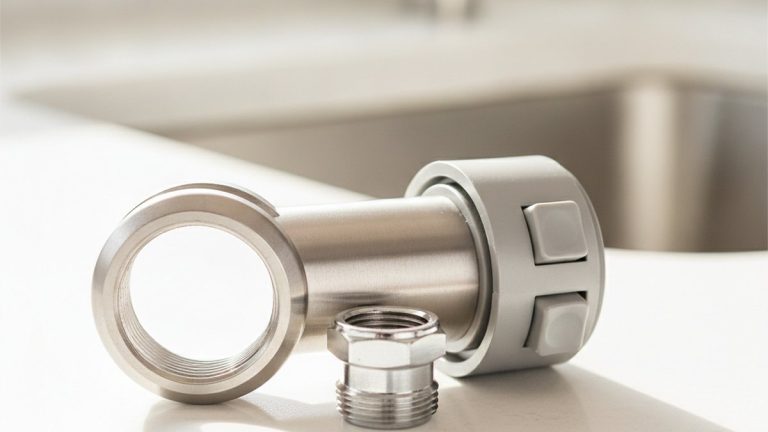
- Cartridge type and rebuild kits: make sure replacement cartridges are stocked and cheap — you will rebuild these.
- Standards listings: ASME A112.18.1/CSA B125.1, plus WaterSense and any local green-building requirement.
- Handle style: push-down or lever for accessibility and vandal resistance.
- Warranty: look for a strong commercial warranty on the finish and valve.
Choosing among all these variables is really the same decision-making process as any restroom fixture, just weighted toward durability and code. If you’re spec’ing a full restroom, our overview on how to choose the right bathroom faucet walks through matching the faucet to the sink, the hole configuration, and the use case.
FAQ
What is the standard hole spacing for a widespread metering faucet?
The standard is 8 inches on center between the two outer (handle) holes, with the spout in a third hole in the middle. “Widespread” technically covers spreads from about 6 to 16 inches, but 8 inches is by far the most common in commercial restrooms. Always measure your existing deck holes before ordering — swapping a widespread for a centerset (4-inch) layout, or vice versa, means re-drilling or replacing the sink.
How long does a metering faucet stay on per press?
Typically 10 to 15 seconds, and on adjustable models you can dial it roughly between 4 and 30 seconds. For ADA compliance the run time must be at least 10 seconds. Set a shorter cycle in very high-traffic, water-sensitive locations and a longer cycle where users expect a full 20-second wash.
Do metering faucets need electricity or batteries?
No. Metering faucets are entirely mechanical — a spring-loaded, self-closing cartridge handles the timed shut-off, so there are no batteries, solenoids, or wiring to fail. That’s their biggest maintenance advantage over sensor (touchless) faucets, which need power and periodic battery changes.
Are widespread metering faucets good for hard water?
They work fine in hard water, but the aerator and cartridge need routine descaling because mineral scale can restrict the already-low flow and slow the self-closing action. Wipe the finish and clean or replace the aerator on a schedule; in very hard water, consider models with easily removable, replaceable cartridges so a scaled valve is a quick swap rather than a full faucet replacement.
How much do widespread metering faucets cost compared to standard faucets?
Expect to pay a modest premium over a basic manual commercial faucet, but the water savings usually recover it within the first year or two in a high-traffic restroom. The bigger cost driver over time is the cartridge: buy a model with inexpensive, widely stocked rebuild kits so ongoing maintenance stays cheap.
Can one metering handle control both hot and cold?
On a true widespread layout, you have two independent handles — one hot, one cold — each with its own metering cartridge, so users can mix temperature. Some commercial metering faucets instead use a single-supply or pre-mixed design where one push delivers tempered water; if temperature control matters for your space, confirm which configuration you’re ordering.
The bottom line for facility managers
A widespread metering faucet is the practical middle ground for most commercial restrooms: real water savings, guaranteed shut-off, ADA-friendly operation, and a look that fits nicer spaces — all without the batteries and electronics of a sensor faucet. Match the flow rate and cycle time to your traffic, confirm the 8-inch spread fits your deck, pick a durable chrome or brushed finish for your water conditions, and make sure rebuild cartridges are cheap and in stock. Do that, and you’ve bought a fixture that quietly lowers your water bill for years.
About the author: This guide was written by the Aniflux Home fixtures team, drawing on hands-on testing of commercial and residential faucet valves across finishes, flow rates, and metering cartridges. Aniflux Home specializes in faucets and bathroom fixtures and evaluates every product against recognized plumbing standards (ASME A112.18.1/CSA B125.1) and EPA WaterSense efficiency criteria. We recommend confirming warranty terms and local code requirements — many commercial metering valves carry multi-year commercial warranties on the finish and cartridge — before specifying at scale.